

From building an emergency cushion and pursuing financial independence to comparing mortgage schedules, inflation measures, and home equity agreements, money decisions often involve tradeoffs beyond the headline promise. Understanding fees, assumptions, timing, and long-term consequences can help you protect your cash flow, avoid expensive surprises, and choose strategies that fit your goals.
Discreet Bail Bonds Near Me
Biweekly vs. Monthly Mortgage Payments: The Real Math
 Biweekly vs. Monthly Mortgage Payments: The Real Math Switch to biweekly billing and pay off your mortgage years early. It's one of the most repeated pieces of mortgage advice out there, and it's only true for one specific version of biweekly billing. There's a second version, also called biweekly, that changes nothing about how much [...]
Mortgage by FangWallet Editors
The FIRE Movement: A Complete Breakdown
Anyone just dipping their toes into the world of personal finance may have seen the term “FIRE” floating around the blogosphere. Mainstream outlets like CNBC, the New York Times, and Vox have even reported on FIRE’s growing popularity in recent years. 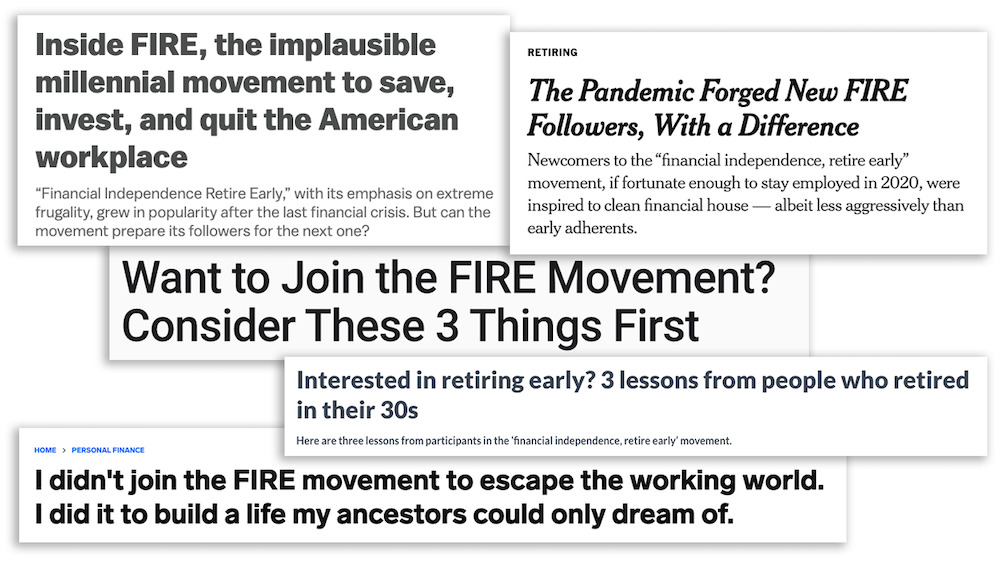 So what is it? FIRE, short for “Financial Independence, Retire Early,” is a lifestyle movement centered around managing one’s personal finances in such a way to retire significantly earlier than the norm.
This begs the question: When exactly is “normal” retirement in the first place?
While we typically imagine retiring at age 65 as the standard, research shows the average retirement age is 62. People pursuing FIRE, however, often aim to retire in their 30s or 40s. Some, even earlier.
Those unfamiliar with the concept may have raised an eyebrow. We get it. Retiring decades before your parents or grandparents did might not sound realistic or feasible.
But the reality is that it’s possible.
We cover all things FIRE below, including the tactics used to achieve it, criticisms, and different philosophies within the movement. We also link to helpful resources like retirement calculators and online communities—so if you’re interested in pursuing FIRE or at least learning more, bookmark this page for easy access.
Quick Links
What is the FIRE movement?
As previously mentioned, “FIRE” stands for “Financial Independence, Retire Early.”
Its main goal: To achieve financial independence or financial freedom—two largely synonymous terms that describe having complete control over your finances. People who are financially independent don’t depend on employment or others for their day-to-day means; instead, they often rely on their savings or investment income to live comfortably. Some also use the phrase “work optional” to describe this lifestyle.
People pursuing FIRE practice a variety of tactics, including:
- Living below one’s means, often in order to save aggressively
- Paying off or reducing expensive debt asap
- Leveraging tax-advantaged accounts like Roth IRAs
- Maximizing employer matching in retirement plans like 401(k)s
- Pursuing part-time work, also known as side hustles
- Creating passive streams of income
No matter how they approach their FIRE goals, people in the FIRE movement are generally united by a desire to spend their time doing what they want rather than what is normally expected by society, e.g., a 9-to-5 job. In this way, the FIRE movement can be considered a philosophy for lifestyle design.
There are many unique motivations behind striving for FIRE. Some people want more autonomy in their day-to-day lives. Some simply hate their jobs or don’t want to work full-time. And some see financial independence as a way to achieve other goals that a traditional lifestyle does not support—like traveling around the world. Oftentimes, people have multiple reasons for pursuing FIRE.
How did the FIRE movement begin?
Many trace the FIRE movement’s origin to a former Wall Street stock analyst named Joe Dominguez. At the age of 31, Dominguez retired with a nest egg of $70,000 to $100,000 (sources differ), and spent the rest of his life living off its interest income. He and his partner Vicki Robin eventually wrote the 1992 book Your Money or Your Life, which laid out a philosophy of frugality and meaningful spending—what effectively became the blueprint for the FIRE movement.
Jacob Lund Fisker’s Early Retirement Extreme, published in 2010, is often also credited as another source of inspiration for the FIRE movement. Like Dominguez, Fisker retired early at the age of 33 after accumulating a net worth 25 times his annual expenses. (As his book’s title suggests, Fisker takes frugality to an extreme—his annual expenses generally total no more than $7,000.)
Together, the two books set forth the idea of aligning one’s finances with their life values. They challenge traditional notions of consumerism, like the idea that “more is better,” and instead promote having “enough.”
These ideas were further popularized in personal finance blogs in the early 2000s and 2010s. One of the most prominent was Mr. Money Mustache, a Canadian software engineer who retired at age 30.
The FIRE movement has since grown tremendously, with hundreds of people blogging about their journeys both publicly and anonymously. Well-known blogs include Mad Fientist, Chief Mom Officer, Our Next Life, Making Sense of Cents, and Rich & Regular—but you can find even more perspectives using Personal Finance Blogs’ regularly updated feed.
Criticisms of FIRE
Like any ideology, the FIRE movement receives its fair share of criticism. Here are the three most common issues people point out:
Extreme lifestyle trade-offs
Many FIRE skeptics point to extreme measures of frugality as taking away from present-day enjoyment of life—and in this way, making FIRE an unattractive pursuit. For example, they cite people who choose to live in a van or forgo long vacations in the name of FIRE.
It’s worth noting here that extreme frugality is not the only way to achieve financial independence. Moreover, such tactics are not for everyone.
Anyone interested in pursuing financial independence can do so on their own terms. For instance, some people focus on strategies to earn more money rather than reduce expenses, and vice versa.
Another point here: Extremity is often in the eye of the beholder. In fact, people taking what others perceive to be extreme measures may not experience any deprivation—on the contrary, they may even enjoy them or argue that it’s their choice. Whatever the case, there is no single route to financial independence.
Inaccurate assumptions
Some critics take issue with FIRE because they feel unpredictable factors like inflation make early retirement more of a gamble than a guarantee. For instance, without a job that provides health benefits in the U.S., retiring early can mean paying out of pocket for exorbitant health costs. Not to mention, global events that might rack the economy—like a pandemic—make financial independence seem rather precarious.
There’s no denying the unpredictability of what might happen during early retirement, both on a macro and micro level. It’s a legitimate concern that can deter many from actively pursuing FIRE—and there’s no real solution.
Still, this doesn’t stop people from striving for financial freedom. Below are several ways they use to mitigate unexpected costs:
- They plan more conservatively in anticipation of unforeseen events and costs.
- They diversify their investments so as not to put all their eggs in one basket—that might be a combination of stocks, index funds, real estate, bonds, etc.
- They take a part-time job that provides health insurance (a variation of the FIRE philosophy known as “Barista FIRE”).
- They pursue full-time work that they enjoy and that also provides benefits. (Example: An investment banker who, after saving a large enough nest egg to reach FIRE, moves into a nonprofit job because of their passion for the cause.)
Taking a job may sound counter to the concept of early retirement. However, financial independence ultimately isn’t about retiring from work altogether—it’s about becoming empowered to live on your own terms. The work-optional lifestyle means you can pursue more fulfilling but low-paying work without feeling financial stress thanks to your savings and investments.
Lack of diversity
While anyone can pursue FIRE, it isn’t a level playing field when it comes to actually achieving it.
The criticism here thus isn’t directed at the philosophy, but rather, broader FIRE recommendations that don’t apply to all followers. These recommendations stem in part from the movement’s origin—FIRE first gained momentum among white male engineers and software developers.
Within the last decade, the movement has grown tremendously in popularity, though resources within the FIRE community did not necessarily reflect these changes. For this reason, some of the traditionally dominant FIRE perspectives may be seen as tone-deaf and inaccessible. People point out that the ability to strive for and obtain financial independence is a privilege that not everyone is afforded because of larger systemic inequalities.
There’s no denying this: The same advice prescribed by a 20-something college graduate working in tech probably won’t apply to a 40-year-old single parent working multiple jobs.
While economic disparities like the retirement savings gap persist, the FIRE movement steadily continues to become more diverse over time, with more women, people of color, and other professions sharing their journeys online. While still a work in progress, there are many new blogs and communities that showcase different perspectives and help make FIRE more accessible than before.
Variations of the FIRE movement
The FIRE movement has evolved considerably over time, with new offshoots and submovements taking root all over. While the end goal remains the same—achieving financial independence—these variations of FIRE are a little more nuanced and/or have certain caveats for what the journey and destination look like. There are many, but below are the five most prominent types of FIRE:
- Lean FIRE: The goal is to achieve enough retirement savings to live on $40,000/year (or less) during retirement. With Lean FIRE, the amount of time required to reach retirement is shorter than with traditional FIRE because the target retirement savings amount is smaller.
- Fat FIRE: Unlike Lean FIRE, Fat FIRE involves saving up a large nest egg to support an upper-middle-class income during retirement. Think an annual spend of $100,000 or more—though of course, this depends on your location. Besides Fat Fire, there’s also Obese FIRE and Mo FIRE (short for “Morbidly Obese FIRE”), which require even more savings.
- Slow FIRE: You can think of Slow FIRE as the response to FIRE criticisms about extreme frugality. People on this path are focused on balancing their desire to achieve financial freedom with enjoying their current lifestyle—they do not want to make every sacrifice necessary to reach FIRE asap.
- Coast FIRE: Not to be confused with Slow FIRE, the Coast FIRE lifestyle involves two phases: an early period of intensive saving and investing, and then “coasting.” People can coast their way to retirement because their early investments increase with enough compounding growth to reach their target retirement amount.
- Barista FIRE: People who have achieved Barista FIRE have saved a large enough nest egg to retire early but continue to work part-time for healthcare benefits—typically until they become eligible for Medicare. While this type of FIRE is inspired by Starbucks, which offers comprehensive medical benefits to part-time employees, other major companies like Costco and REI also offer health insurance to part-time workers.
Resources
Google “FIRE movement” and you can find all kinds of articles and blog posts offering tips on how to achieve FIRE. It can be a little overwhelming—we know. So we rounded up the resources that we’ve found most useful for learning and meeting like-minded FIRE followers.
FIRE Calculators
One common starting point for pursuing financial independence: determining your “FIRE number,” the amount of invested retirement money needed to live off the returns. Think of this as your savings and investment goal—the target needed to successfully reach financial freedom. While many use 25 times your annual spending (25 x your annual expenses) as a general rule of thumb, there are also dozens of online tools for finding your FIRE number.
Here are a few of the most reputable calculators:
- FI Calc
- Mustache Calc
- Coast Fire Calculator (from WalletBurst)
- Flexible Retirement Planner
- Side Hustle FIRE Calculator
Reddit and Online Communities
- r/personalfinance: With 15.8 million members, this is perhaps the largest subreddit dedicated to money—specifically, budgeting, savings, paying off debt, investment, and retirement planning. Note that not all members are focused on achieving financial independence. However, we recommend starting here to learn about basic personal finance principles.
- r/financialindependence and r/fire: These two communities are filled with discussions about achieving financial independence. For those new to FIRE, the financial independence subreddit’s wiki is an excellent guide. For those interested in a specific type of FIRE, you can also find subreddits for each submovement.
- r/bogleheads: “Bogleheads” are investors who follow principles set forth by Jack Bogle, the founder of Vanguard and creator of index investing. Bogle famously advocated for passive investing strategies that rely on funds with lower turnover, management fees, and expense ratios.
- r/frugal: Like the personal finance subreddit, this community isn’t necessarily focused on achieving financial independence (though there is certainly overlap). Members regularly share tips for saving money and living more frugally.
- r/realestate and r/realestateinvesting: These two subreddits are intended for discussions about homeownership and real estate investing, a strategy that some FIRE followers are big proponents of.
- /r/MoneyDiariesACTIVE/: Inspired by Refinery29’s anonymous Money Diaries series, this subreddit isn’t specific to the FIRE movement. However, members share practical personal finance advice that may apply to those pursuing financial independence. It’s women-focused, meaning more alternative perspectives missing from other male-dominated subreddits.
- ChooseFI: ChooseFI is an educational media company with a community built around empowering people to reach financial independence. This is the main Facebook group—however, there are also many local groups around the world that plan regular meetups and events.
- Women’s Personal Finance (Women On FIRE): Developed for women and non-binary people, this community offers both free and premium memberships. The Facebook group (linked here) is free to join, and members regularly ask for and share thoughtful advice.
Books, YouTube Channels, and Podcasts
For each of these categories, there are hundreds of resources related to personal finance. We’ve curated just a small selection of quality ones below. Not all focus explicitly on tactics for achieving financial independence, but they’re worth checking out to build a stronger foundation of personal finance knowledge.
- Books:
- The Millionaire Next Door: The Surprising Secrets of America’s Wealthy by Thomas J. Stanley and William D. Danko (1996)
- I Will Teach You To Be Rich by Ramit Sethi (2009)
- Side Hustle: From Idea to Income in 27 Days by Chris Guillebeau (2017)
- Podcasts:
- Afford Anything: Thoughtful interviews and Q&As that provide financial tips as well as career and productivity advice. Most episodes run 60-75 minutes.
- ChooseFI: Practical and actionable advice about pursuing FIRE. Most episodes run 40-60 minutes.
- Money for the Rest of Us: Concise, straightforward breakdowns of financial and economic topics. Most episodes run under 30 minutes.
- The Money with Katie Show: Sharp, incisive insights about personal finance with personality. Episodes vary more widely in length but are usually 20-50 minutes.
- YouTube channels about side hustles and passive income: Emilia Gardner, Income School, Passive Income Geek, Side Hustle School
The post The FIRE Movement: A Complete Breakdown first appeared on Financial Impulse.
Read more from: Financial Impulse
Build a Starter Emergency Fund Before Anything Else
One surprise car repair or medical bill can undo months of progress if you have nothing set aside. Before investing or attacking debt, save a starter emergency fund of one month of expenses. Grow it to three to six months as the rest of your financial order falls into place.Read the rest by: Andrew Schrage
The Government Is About to Make Inflation Look Lower — 6 Things That Means for Your Money

Here’s something worth knowing before the next inflation headline lands: The most important number the Federal Reserve watches is about to get smaller. Not because prices are falling. Because the government’s changing how it does the math. On Sept. 30, the Bureau of Economic Analysis (BEA) will roll out new methods for measuring a handful of prices inside its main inflation gauge — the Personal…
Follow the story by: Stacy Johnson CPA
Home Equity Agreement: What “No Monthly Payment” Really Costs
A home equity agreement can sound simple: cash now, no monthly payment, and no traditional loan. But the cost often shows up later, and it may be far higher than it first appears. Here is what a home equity agreement really is, where the risk lives, and what to compare before you sign.
Read all the article at: Todd Christensen
Comments
Post a Comment